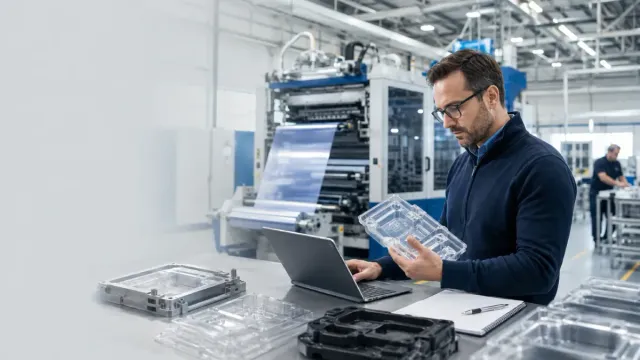
What Is Thermoforming? Process, Types and Applications
A practical introduction to the thermoforming process, including vacuum, pressure and twin-sheet forming, materials, applications, benefits and design limits.
Thermoforming is a manufacturing process that turns a flat thermoplastic sheet into a three-dimensional part. The sheet is heated until it becomes flexible, shaped against a mould, cooled, and then trimmed to its final outline. The method is used for everything from disposable food trays to vehicle panels, medical equipment housings, refrigerator liners, machine guards, and large industrial covers.
The basic idea is simple, but the results depend on careful control of material temperature, stretching, mould design, cooling, and trimming. Understanding the thermoforming process makes it easier to choose the right production method, prepare a realistic project brief, and speak with manufacturers about tooling, tolerances, volumes, and cost.
How the thermoforming process works
Most production follows the same sequence, whether the material arrives as individual cut sheets or is fed continuously from a roll.
1. The sheet is loaded and clamped
A thermoplastic sheet is placed in a frame or indexed into the forming station. Sheet-fed machines are common for larger parts and lower or medium production volumes. Roll-fed systems are widely used for packaging and other high-volume products.
The usable forming area is smaller than the overall sheet because material is needed around the edges for clamping and sealing.
2. The plastic is heated
Heaters raise the sheet to its forming temperature. The goal is not to melt the material into a liquid, but to soften it enough to stretch without tearing or creating uncontrolled thin areas.
Heating must suit the polymer, sheet thickness, colour, and geometry. Uneven temperature can cause poor detail, webbing, excessive sag, weak corners, or inconsistent wall thickness.
3. The sheet is shaped over or into a mould
Once soft, the sheet is brought into contact with a male or female mould. Vacuum, positive air pressure, mechanical movement, or a combination of these forces draws the material against the tool.
Deep parts often need a plug assist or pre-stretching step. These methods guide material into difficult areas before final forming and help improve wall-thickness distribution.
4. The part cools
The formed sheet remains against the mould until it becomes stable enough to retain its shape. Cooling may be assisted by fans, controlled air, water-cooled tooling, or other production systems.
Removing a part too early can lead to distortion. Excessive cooling time, however, reduces output, so mould temperature and cooling strategy are important parts of cycle development.
5. The part is released and trimmed
Air may be introduced to help release the formed sheet from the mould. The finished component is then separated from the surrounding material.
Depending on the product, trimming may be completed with a steel-rule die, punch press, router, five-axis CNC machine, laser, or another cutting system. Drilling, bonding, welding, printing, painting, assembly, and inspection can follow.
Main types of thermoforming
“What is thermoforming?” has more than one practical answer because several forming methods sit under the same process family.
Vacuum forming
Vacuum forming removes air from between the heated sheet and the mould. Atmospheric pressure pushes the plastic against the tool surface.
It is widely used for trays, housings, liners, covers, displays, prototypes, and large industrial parts. Relatively low forming pressure can allow simpler tooling than processes that operate at much higher pressure. The trade-off is that very fine surface detail and sharp features may be harder to reproduce without additional forming aids.
Pressure forming
Pressure forming adds positive air pressure above the heated sheet, usually together with vacuum below it. The higher pressure can produce sharper detail, tighter surface definition, textured finishes, and features that may resemble injection-moulded parts.
It is often considered for equipment bezels, medical housings, electronics enclosures, interior panels, and other visible components where appearance matters. Tooling and process control are generally more demanding than for basic vacuum forming.
Twin-sheet forming
Twin-sheet forming heats two sheets and forms them in matched tooling. The sheets are joined around selected areas to create a hollow part.
The process can produce rigid structures with enclosed air space, internal channels, double walls, and mounting features. Typical applications include pallets, ducts, tanks, doors, transport components, and products that need stiffness without becoming a single thick solid section.
Mechanical and matched-mould forming
Some systems use mechanical force, matched tools, plugs, or diaphragms to shape the sheet. These techniques may be used alone or combined with vacuum and pressure when a part needs controlled stretching or specific detail.
The correct method is determined by geometry, material, surface requirements, annual volume, and the available equipment—not simply by the name of the process.
Thin-gauge and heavy-gauge thermoforming
The industry often separates projects by starting sheet thickness and feeding method.
Thin-gauge thermoforming commonly uses roll-fed material and automated forming, cutting, and stacking. It is strongly associated with packaging, cups, lids, trays, blister packs, and disposable containers.
Heavy-gauge thermoforming usually starts with individual cut sheets and produces more durable parts such as vehicle interiors, machinery panels, appliance liners, medical housings, and industrial enclosures. These components often require CNC trimming and additional assembly.
There is no single thickness boundary used by every company. Buyers should therefore describe the actual sheet thickness, part dimensions, draw depth, and annual quantity rather than relying only on labels such as thin-gauge or heavy-gauge.
Materials used in thermoforming
Only thermoplastics can be reheated and shaped in this way. Common sheet materials include:
- ABS for impact-resistant housings, panels, and vehicle components;
- HIPS for economical trays, displays, liners, and general-purpose parts;
- PET and PETG for clear packaging, medical products, displays, and formed components;
- PP for packaging, chemical resistance, and applications that may use living hinges;
- HDPE for durable liners, tanks, trays, and industrial products;
- PVC for packaging, displays, and specialist technical applications;
- acrylic for clear displays, lighting covers, signage, and visual parts;
- polycarbonate for impact resistance, transparency, and demanding enclosures.
Material selection is not based on appearance alone. Forming range, moisture sensitivity, shrinkage, chemical resistance, UV exposure, fire performance, food-contact requirements, recycled content, sheet availability, and secondary operations all affect the decision.
Where thermoformed products are used
Thermoforming serves both short-run specialised manufacturing and highly automated mass production.
Packaging is one of its most visible uses: food trays, clamshells, cups, lids, blister packs, medical packaging, and handling trays. In transport, the process is used for interior panels, luggage components, seat parts, cab trim, and large covers. Industrial applications include machine guards, control housings, ducts, protective panels, work-in-process trays, and equipment enclosures.
It is also common in appliances, retail displays, sanitary products, agriculture, aerospace interiors, construction, leisure products, and prototypes. The practical range is broad because the same process family can handle small thin-walled products and large structural components.
Advantages and limitations
Thermoforming can offer economical tooling, comparatively fast tool manufacture, large part capability, short development cycles, and a wide choice of colours, textures, and sheet constructions. It can be attractive for prototypes, bridge production, medium-volume components, and high-volume packaging.
The process also has constraints. A formed part begins as a sheet, so wall thickness changes as the material stretches. Deep draws, sharp corners, undercuts, and tight tolerances require careful design. Trimming is usually necessary, and the surrounding sheet skeleton must be managed through reuse, regrinding, recycling, or disposal according to the material and production system.
Only one side of the sheet directly contacts the mould in many conventional setups. This affects which surface receives the best tool definition. Good design accounts for draft angles, radii, material flow, trim access, mounting points, and the visible side before tooling is built.
Is thermoforming right for a project?
Thermoforming is worth considering when a product is made from thermoplastic sheet, especially when it is large, relatively thin-walled, needs a textured or coloured surface, or must be launched without the tooling investment associated with some alternative moulding processes.
A supplier will usually need the part dimensions, 3D model or drawing, preferred material, starting sheet thickness, annual volume, batch size, tolerances, surface expectations, secondary operations, and delivery location. These details determine whether vacuum forming, pressure forming, twin-sheet forming, or another process is appropriate.
Thermoforming Hub brings together manufacturers, machine builders, tooling companies, material providers, and specialist services in one industry directory. Explore the company directory to compare relevant partners, or visit the client portal guide to see how company profiles and upcoming sourcing tools are organised.